When the Earth speeds up unexpectedly what it means for time climate and technology
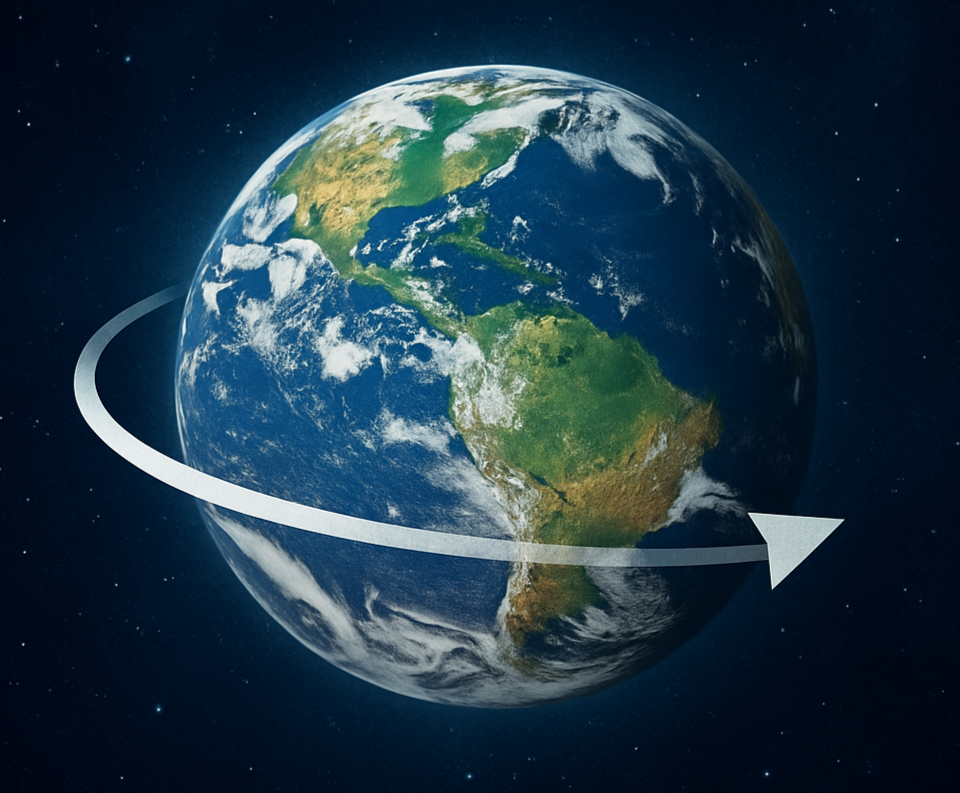
Imagine waking up one morning and discovering that your watch, GPS, and the way scientists measure time are slightly out of step with the sky. That scenario moved out of thought‑experiment territory in recent years, as researchers reported an unexpected shortening of the day and debated what it could mean for timekeeping, climate science, and the technologies we depend on.
In short: tiny changes in Earths rotation can ripple into big practical problems. Below I explain why, cite the evidence, and highlight what engineers and policymakers should be thinking about next.
a quick primer: what are LOD, UTC, and UT1?
- Length of day (LOD): the actual duration of one Earth rotation, usually expressed as how much it differs from 86,400 SI seconds. Small variations are measured in milliseconds.
- UTC: Coordinated Universal Time, the civil time standard based on atomic clocks. UTC is kept close to Earth rotation using leap seconds when needed.
- UT1: a measure of Earth rotation angle in time units; differences between UT1 and UTC tell us how much astronomical time and atomic time diverge.
These are not abstract labels. LOD and UT1 are the bridge between celestial motion and everyday clocks; when that bridge shifts, navigation and communications feel the effects.
what scientists actually found
Three recent studies sketch the current picture and its uncertainty.
- Duncan Agnew in Nature analyzed recent acceleration in Earth's rotation and projected that, absent countervailing effects, the divergence between Earth rotation and atomic time could have required a negative leap second in the late 2020s. He then showed that climate-driven polar ice melt moves mass toward the equator, increasing Earth's moment of inertia and delaying that need by a few years (Nature, Mar 2024) [https://www.nature.com/articles/s41586-024-07170-0].
- A broad PNAS analysis reconstructed 1900–present LOD drivers and concluded that climate-driven mass redistribution has become an increasingly dominant influence on LOD since about 2000. Under high‑emission scenarios the climate contribution to LOD could reach multiple milliseconds per century by 2100, overtaking long-term tidal effects and materially affecting timekeeping and satellite operations (PNAS, Jul 2024) [https://www.ncbi.nlm.nih.gov/pmc/articles/PMC11287281/].
- Zinovy Malkin emphasized caution: the recent speedup may be a transient fluctuation rather than a long-term trend. He showed that prediction depends heavily on smoothing and model choices; decisions based on naive extrapolation risk committing to policy changes for what could be short‑lived signals (arXiv, Apr 2024) [https://arxiv.org/abs/2404.06343].
Some have called these findings revolutionary because they force us to treat climate change as affecting not just ecosystems but the planet's rotation and the foundations of timekeeping.
why this matters for timekeeping and technology
- leap seconds are delicate. Systems were mostly built expecting positive leap seconds (adding a second). A negative leap second (subtracting a second) has never been implemented and could cause synchronization failures in distributed computing, telecommunications, and satellite systems (Agnew, Nature).
- GNSS and space missions need extreme timing precision. Millisecond LOD errors translate into meter‑scale positional errors for GPS and can complicate deep‑space navigation if not correctly modeled (PNAS).
- financial markets, power grids, and telecom networks rely on precise time stamps. Even brief desynchronization can cascade through automated systems.
Real-world example: orbit prediction for an Earth‑bound launch or interplanetary burn uses both atomic-time ephemerides and Earth rotation parameters. Small timing drift, if unmodeled, can change where a spacecraft reenters or where a probe points its antenna.
where climate comes in
Melting ice and changing water storage on land shift mass from poles toward the equator, increasing Earths moment of inertia and slowing rotation. Conversely, fluid core dynamics and exchanges between mantle and core can speed rotation. The current picture is a tug of war: internal geodynamics pushed toward a speedup, while climate-driven redistribution has countered and complicated the trend (Agnew; PNAS).
The PNAS team quantified this shift, showing the climate contribution to LOD has increased since 2000 and could, under high emissions, dominate secular changes by century's end [https://www.ncbi.nlm.nih.gov/pmc/articles/PMC11287281/]. That connects climate policy directly to the metrics we use for time.
uncertainties and why caution matters
Malkin warns against treating recent acceleration as permanent. Earth rotation reflects many oscillations — annual, multi‑year core–mantle coupling cycles, and random variability. Prediction beyond a few years remains noisy, and policy decisions (like changing UTC rules) should account for that uncertainty [https://arxiv.org/abs/2404.06343].
why this matters
- Operational risk: unexpected time adjustments could disrupt satellites, telecom, and financial systems.
- Scientific insight: rotation changes are another measurable fingerprint of climate change at planetary scale.
- Policy implications: metrology authorities may need new rules for leap seconds or more robust guidance and migration plans for industry.
questions to ponder
- Should UTC rules be altered to avoid the risk of negative leap seconds, even if the signal might be transient?
- How much should climate models used for LOD projections shape international timekeeping policy?
- Are critical infrastructures sufficiently hardened to handle a subtractive leap second if it ever happens?
what to do next: practical steps
- strengthen monitoring and prediction: continuous geodetic, satellite gravity (GRACE), and seismological data flow into improved, probabilistic LOD forecasts (PNAS).
- test systems for negative leap scenarios: software and network engineers should rehearse subtractive-second events in controlled environments (Agnew).
- international coordination: timekeeping bodies, space agencies, telecom regulators, and industry must align contingency plans.
conclusion: a small change with outsized consequences
The idea that Earths rotation could speed up enough to force a negative leap second sounds dramatic, but the truth is nuanced. The best current science shows a mix of drivers: internal core dynamics nudging toward acceleration, and climate-driven mass shifts pushing back. The outcome is uncertain, but the stakes are concrete — precise time underpins navigation, communications, finance, and scientific measurement.
Treating these findings as revolutionary is not hyperbole: they expand climate change from temperature and sea level into the very rhythm of the planet. Whether the observed speedup proves transient or sustained, the prudent path is clear: better forecasting, coordinated policy, and engineering rehearsals for worst‑case timing events.
What will you check first when your devices next say the wrong second?
Original source: https://www.nature.com/articles/s41586-024-07170-0
Further reading: - Agnew D. C., Nature 2024. https://www.nature.com/articles/s41586-024-07170-0 - Kiani Shahvandi M. et al., PNAS 2024. https://www.ncbi.nlm.nih.gov/pmc/articles/PMC11287281/ - Malkin Z., arXiv 2024. https://arxiv.org/abs/2404.06343