Why 2025 could be a turning point in the fight against Alzheimer’s disease
Introduction
For decades Alzheimer’s disease has felt like an immovable mountain: slow-moving, devastating, and resistant to treatments that change its course. In 2025, however, scientists, regulators and clinicians began to see a different horizon. Regulatory validation of anti-amyloid therapies in Europe, faster and cheaper biomarker screens, AI-driven early detection, and data-driven strategies to balance benefit and safety are converging. These advances don’t promise a cure overnight, but they do create a realistic pathway to slow, manage, and — for some people — prevent progression earlier than ever before.
What changed in 2025
The European approval of a disease-modifying anti-amyloid antibody has been a catalyst. Experts in nuclear medicine and neurology emphasize that this approval transforms scientific progress into a systems problem: how to identify eligible patients with biomarker certainty, deliver infusions safely, monitor adverse effects, and ensure equitable access across health systems EANM editorial. Alzheimer Europe adds the policy perspective: approvals are a first step that must be matched with scaled diagnostics, national care pathways, registries, and reimbursement strategies to make benefits real for people across Europe Alzheimer Europe position paper.
Advances in early diagnosis: the AI and biomarker tandem
A major bottleneck has been finding the right people early enough. Two recent trends change that equation: blood (plasma) biomarkers and artificial intelligence applied to neuroimaging. Plasma assays for phosphorylated tau (p-tau) and Aβ42/40 ratios can serve as inexpensive triage tests. When combined with AI models that analyze MRI and PET — using convolutional neural networks, attention mechanisms, and multimodal fusion — sensitivity for predicting progression from MCI to AD improves markedly AI review (arXiv). These approaches reduce reliance on scarce PET capacity by prioritizing who needs confirmatory imaging.
A brief nod to pioneers: John Hopfield showed how neural networks can store and retrieve patterns (theoretical associative memory, Science 1982) and Geoffrey Hinton helped spark modern deep learning breakthroughs that made image-based AI practical (notably the ImageNet convolutional network revolution in 2012) — both contributions underpin today's neuroimaging AI tools Hopfield 1982, Krizhevsky et al. 2012.
Safer and more precise therapies: what modeling tells us
Real-world deployment raises safety questions — notably amyloid-related imaging abnormalities (ARIA). A recent mechanistic, data-driven model of Aβ aggregation and antibody pharmacodynamics suggests ways to optimize dosing to maximize plaque clearance while minimizing transient increases in toxic soluble oligomers and ARIA risk. Simulations indicate that individualized ramp-up or intermittent regimens and patient-specific dosing (based on baseline plaque burden, age, vascular fragility) can preserve efficacy while reducing adverse events data-driven modeling (arXiv). These quantitative frameworks are tools for trial design and post-marketing safety strategies.
Turning science into practice: operational realities
Experts warn that regulatory approval alone is not enough. Practical challenges include:
- diagnostic capacity: demand for amyloid PET and CSF/plasma testing will rise quickly — many centers lack throughput today EANM editorial;
- infusion logistics and monitoring: clinics need ARIA surveillance protocols and infusion infrastructure;
- equity and reimbursement: national health technology assessments and negotiating fair prices will shape who gets access Alzheimer Europe position paper;
- real-world data: registries and harmonized imaging/biomarker standards are critical to learn about long-term effectiveness and safety.
Case study: a hypothetical pathway
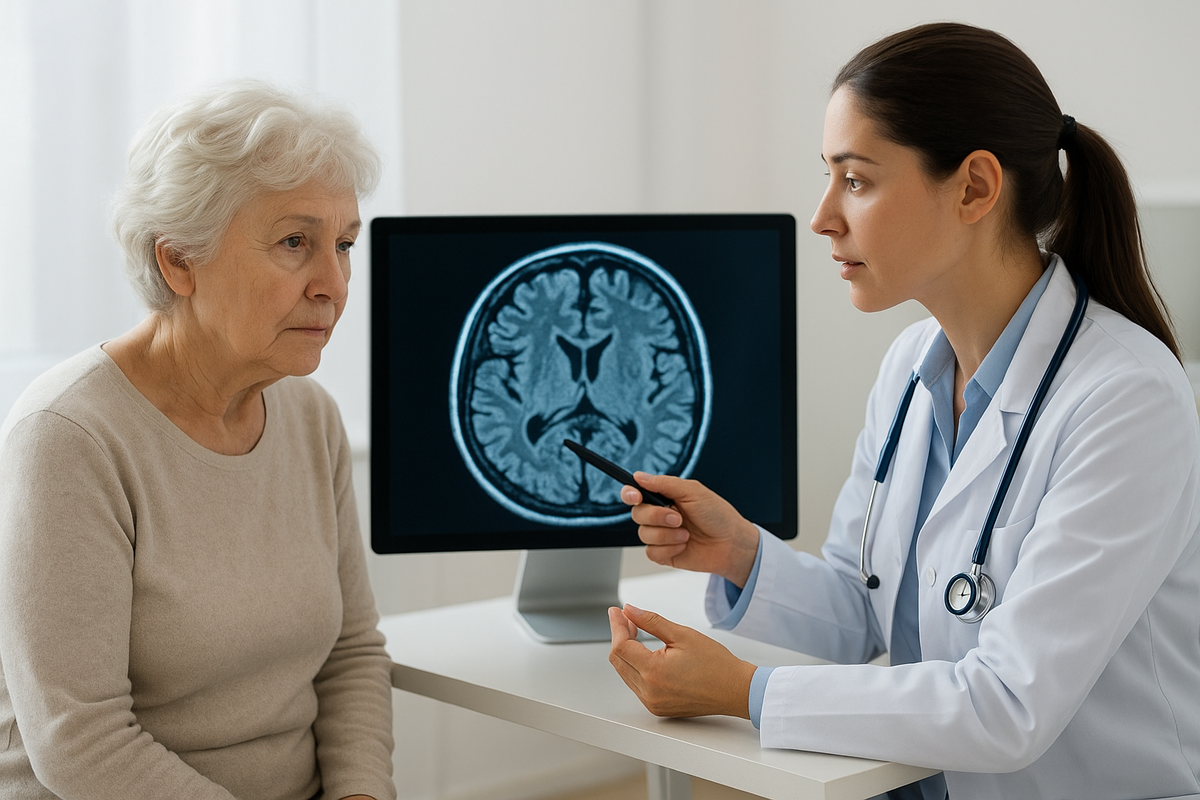
Consider a 68-year-old with subtle memory complaints. A primary-care blood test for p-tau flags elevated risk. An AI-enhanced MRI analysis increases the posterior probability of early AD and prioritizes the patient for confirmatory amyloid PET. After biomarker confirmation, a tailored antibody regimen is initiated with a ramp-up dosing schedule informed by model-based risk assessment and close MRI surveillance for ARIA. The patient joins a registry for long-term outcomes — a pathway made possible by the confluence of the 2025 advances described above.
Why this matters
- People: earlier detection and disease-modifying options can slow decline and preserve independence for more years.
- Systems: scalable plasma tests and AI triage reduce pressure on specialized imaging and make care pathways more efficient.
- Science: model-guided dosing and registries accelerate learning, improving safety and tailoring therapy.
This article is considered revolutionary in that it reframes Alzheimer’s care from reactive comfort measures to proactive, biomarker-driven intervention that integrates AI and systems-level planning.
Questions to consider
- How should national health systems prioritize investment: more plasma assays, PET scanners, infusion clinics, or registries?
- Who decides which patients are eligible when supplies or budgets are limited?
- How can we ensure underrepresented populations are included in registries and trials so AI tools generalize fairly?
Conclusion: cautious optimism and concrete next steps
2025 is not the finish line — it is a pivot. Approvals and technological advances give clinicians the tools to intervene earlier and more safely, but realizing population benefit depends on diagnostics scale-up, thoughtful policy on access and payment, and model-driven personalization. Concrete next steps that would accelerate impact include nationally coordinated biomarker programs, infusion and ARIA-monitoring hubs, and pan‑European registries to collect real‑world effectiveness and safety data.
Imagine a future where a simple blood test at a routine check-up flags someone at risk long before serious symptoms appear; where targeted therapy slows disease for years; and where AI helps clinicians choose safe, individualized dosing. That future is now materially nearer than it was a few years ago — and it will require collaboration between scientists, clinicians, policymakers, and people living with dementia to make it real.
Original source: https://link.springer.com/article/10.1007/s00259-025-07066-9